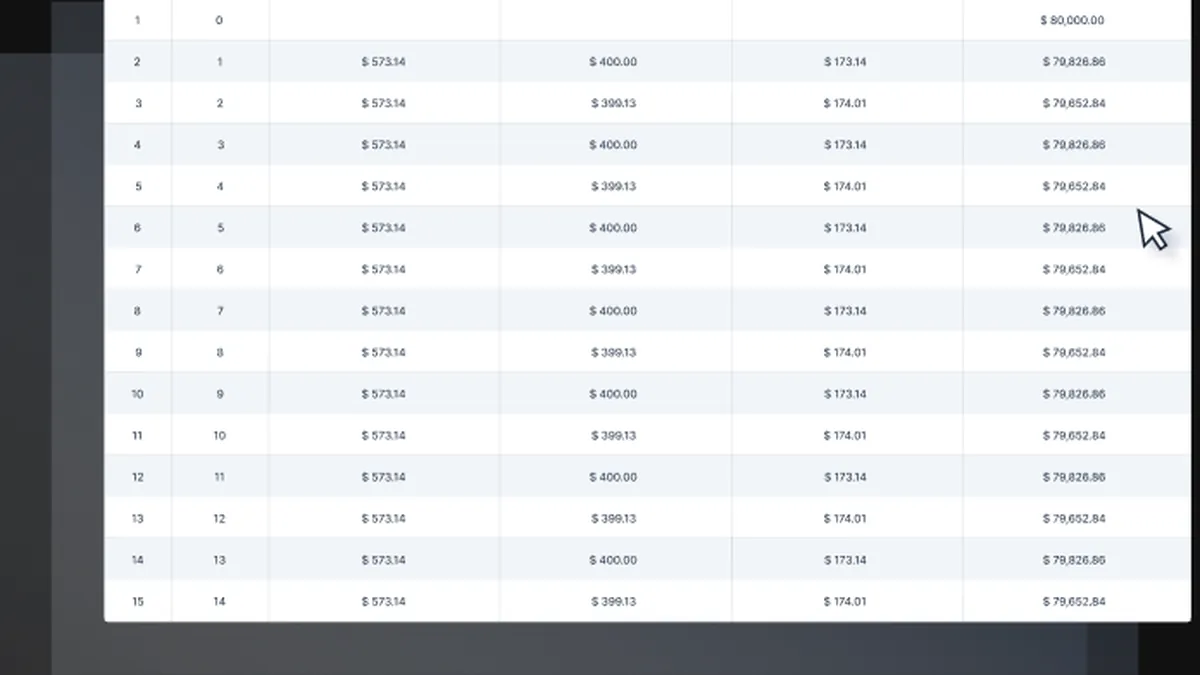
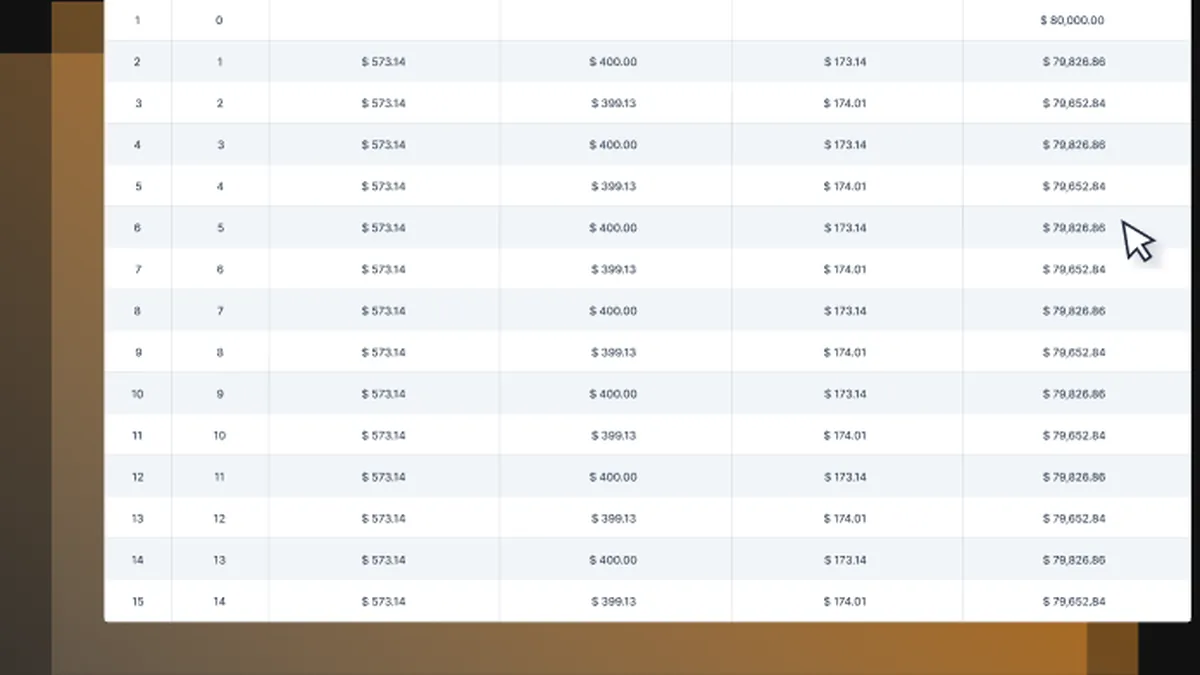
When you finance a rental property, the monthly mortgage payment is usually fixed. What changes every month is how that payment is split between interest and principal. That split, laid out month by month, is your amortization schedule, and it has a bigger effect on your returns than most investors realise.
How the monthly payment is calculated
For a standard fixed-rate loan, the payment is calculated so the loan is fully repaid by the end of the term:
Payment = P × r(1 + r)ⁿ ÷ [(1 + r)ⁿ − 1]
- P is the loan amount
- r is the monthly interest rate (annual rate ÷ 12)
- n is the number of monthly payments
Each month, interest is charged on the remaining balance. Whatever is left of the payment reduces the principal.
A worked example
Take a $300,000 loan at 6.5% over 30 years:
- Monthly payment: $1,896.20
- First month's interest: $300,000 × (6.5% ÷ 12) = $1,625.00
- First month's principal: $1,896.20 − $1,625.00 = $271.20
In the first month, about 86% of the payment is interest. As the balance falls, the interest portion shrinks and the principal portion grows:
- After 5 years, the balance is about $280,800, and roughly $94,600 of interest has been paid
- After 10 years, the balance is about $254,300
- After 15 years, it is about $217,700
- After 20 years, it is about $167,000
Over the full 30 years, total interest comes to roughly $382,600, more than the original loan.
Why this matters for investors
Equity builds slowly at first
Principal paydown is a real part of your return, but in the early years it is small. If you plan to sell or refinance within five years, most of what you paid went to interest.
Your true return includes loan paydown
Cash flow is only one piece. Equity from principal paydown adds to your total return every month, even when cash flow is thin. A good analysis shows both.
Refinancing resets the clock
A new 30-year loan starts the amortization schedule again, with mostly interest in the early payments. That can improve monthly cash flow, but it slows equity growth.
Comparing loan terms
The same $300,000 at 6.5% over 15 years costs about $2,613 a month, around $717 more than the 30-year loan. Total interest falls to roughly $170,400, less than half.
For investors, the right choice depends on strategy:
- A 30-year term maximises monthly cash flow and flexibility.
- A 15-year term builds equity much faster but ties up more cash each month.
The effect of extra payments
Adding $200 a month to the 30-year example pays the loan off in about 23 years instead of 30 and saves roughly $103,000 in interest. Extra payments go straight to principal, so they have the most impact early in the loan.
Whether that beats investing the $200 elsewhere, such as in your next down payment, depends on your interest rate and your expected returns.
Other loan structures investors use
Real-world financing is often more complex than a simple fixed-rate mortgage:
- Interest-only periods keep payments low at first but build no equity.
- Adjustable-rate loans change the payment when the rate resets.
- Balloon loans require a large final payment or a refinance.
- Seller financing can have custom terms and schedules.
Each changes cash flow and risk, so model them before you commit.
Modelling amortization in your analysis
The Viqsa Deal Analyzer builds full amortization schedules automatically and supports the loan structures investors actually use. Because it links the schedule to 30-year projections, you can see cash flow, principal paydown and equity growth together, and compare different financing options side by side before you make an offer.
Key takeaway: Two loans with similar payments can produce very different long-term results. Look at the amortization schedule, not just the monthly payment, to understand how much of your return comes from equity and how quickly it builds.